How we made our own website easier for AI tools to read
We ran Novagentum on novagentum.ai, followed the fix briefs in our redesign, and checked the result with the same Crawl.
By Novagentum team ·
- Pages with a clear main content area
- All pages
- Up from about half.
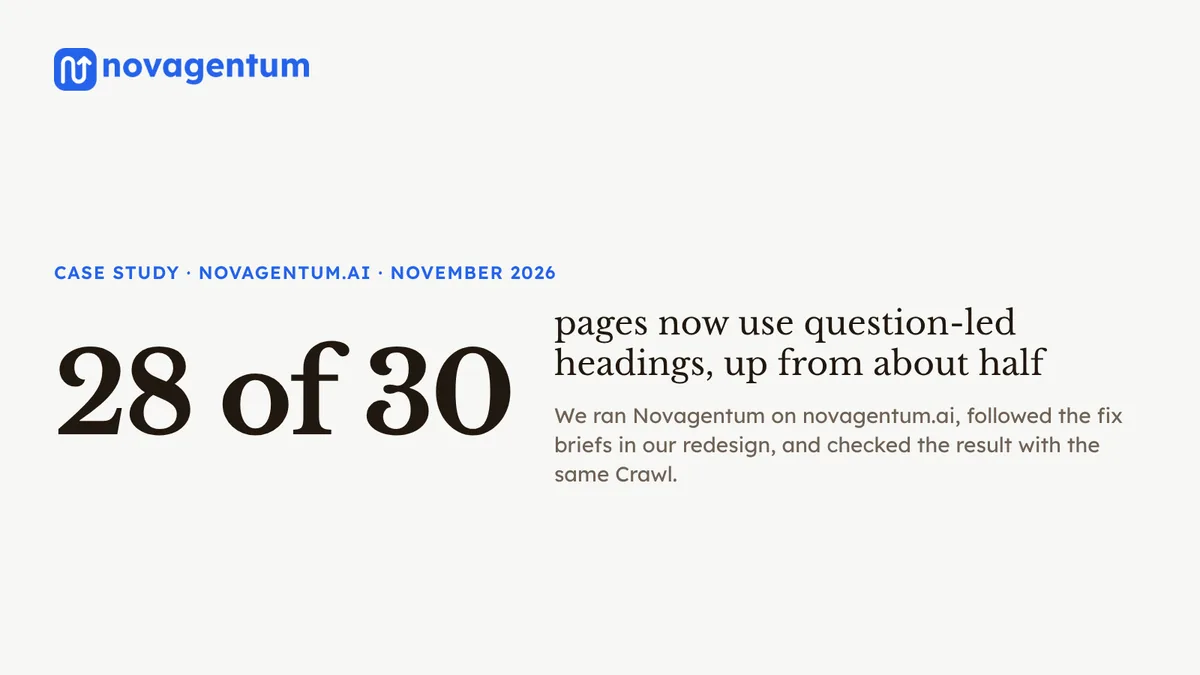
- Pages with question-led headings
- 28 of 30
- Up from about half.
- Time for a full Crawl
- 6 seconds
- So checking again costs nothing in time.
The goal
We help people make their websites easy for search engines and AI tools to read. So our own website had to be a good example. Before our redesign, we ran a Crawl on novagentum.ai to see where we could do better.
What the Crawl showed
The basics were mostly in place: titles, descriptions, canonical links, Organization schema and a sitemap. The Crawl pointed to three places where we could make the site clearer for machines:
- A clear main content area on every page, so AI tools know exactly which part of the page is the content.
- Headings that answer questions, like the ones people ask AI tools.
- WebSite schema and a security.txt file, two small things that complete the picture.
Each finding came with the page it was on and a fix brief, so we could hand it straight to the people building the redesign.
What we changed
We built all three into the new design:
- Every page template now wraps its content in a
mainelement. - Product and help pages now use headings that answer real questions, such as "How much does a Crawl cost?" and "Can I use Novagentum from code?"
- WebSite schema and security.txt are in place.
The result
| Before | After | |
|---|---|---|
| Pages with a clear main content area | About half | All pages |
| Pages with question-led headings | About half | 28 of 30 |
| WebSite schema | Not yet | In place |
| security.txt | Not yet | In place |
We checked the new site with the same Crawl before launch. When it's live, we'll crawl novagentum.ai again and update this page.
What you can take from this
- Start with a Crawl, not a guess. It shows exactly which pages to work on.
- Fix templates, not pages. We changed a handful of templates, and every page built from them improved.
- Check again with the same Crawl. It runs the same checks every time, so you can see what changed.
Questions about this case study
Does Novagentum use its own product?
Yes. We crawled novagentum.ai, used the findings and fix briefs in our redesign, and ran the same Crawl again to check the changes.
What is a main content area and why does it matter for AI answers?
A main element marks where the real content of a page starts and ends. Search engines and AI tools use it to separate your content from menus and footers, so they quote the right part of the page.
Why add headings that answer questions?
People ask AI tools questions. A heading that answers one, followed by a clear answer, gives the tool a passage it can use.