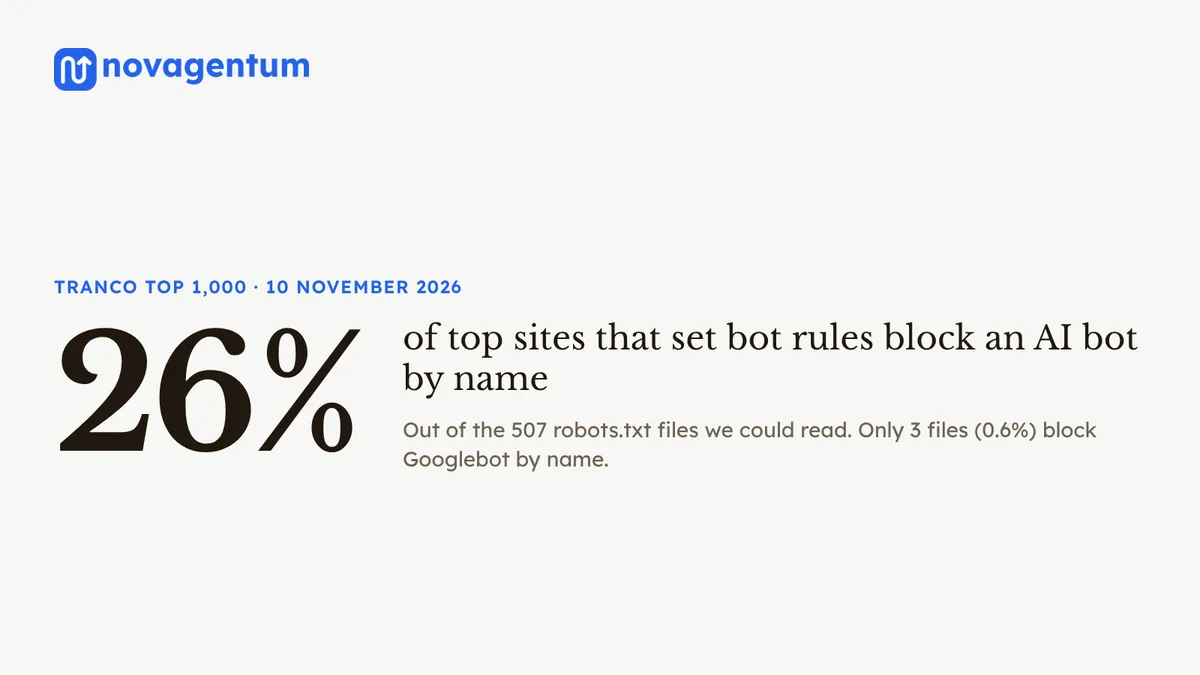
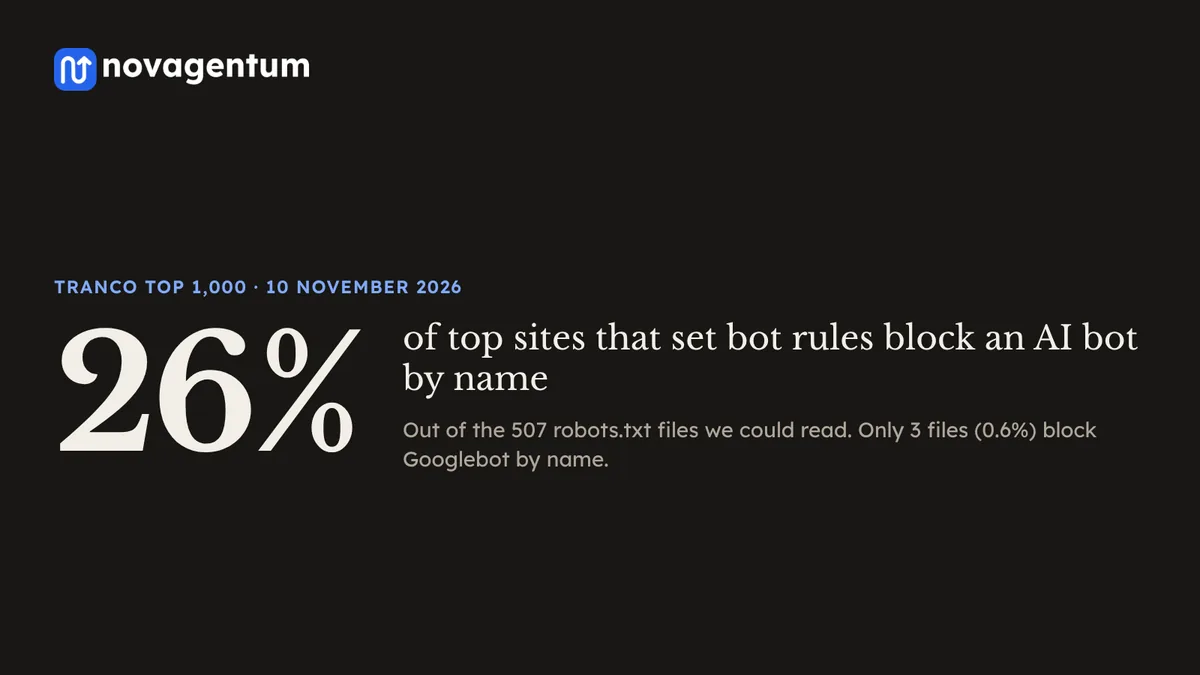
1 in 4 top websites that set bot rules block an AI bot by name
By Novagentum team ·
Have you ever asked ChatGPT or Claude a question and seen it quote a website? To do that, an AI company first has to visit the site and read it.
More and more websites now have an opinion about that. Some say yes. Some say no. Many say "yes, but only for some things."
We wanted a clear, fresh number. So we checked the 1,000 most visited websites. Then we counted how many tell AI bots to stay out.
First: how a website talks to bots
A crawler, or bot, is a program that visits web pages on its own. It reads them and saves what it finds. Google uses a crawler called Googlebot to build its search results.
An AI crawler does the same job for an AI company. OpenAI, Anthropic, Google, Perplexity and others all run their own.
Every crawler has a name it uses when it visits. For example, OpenAI's main crawler is called GPTBot. Anthropic's is called ClaudeBot.
Most websites have a small text file called robots.txt. It sits at the same place on every site, for example example.com/robots.txt. It's a list of house rules for bots.
A site can write rules for one bot by name: "GPTBot, please stay out." It can also write a catch-all rule for every bot it didn't name. In this post, blocking a bot by name means one thing. The site wrote a rule for that exact bot, and the rule says "stay out of the whole site."
AI crawlers come in two main kinds:
- Training crawlers collect pages to teach, or train, an AI model. The pages become part of what the AI learns. GPTBot and ClaudeBot are training crawlers.
- Search crawlers fetch pages so an AI can find and quote them when someone asks a question. OpenAI's is called OAI-SearchBot. Anthropic's is called Claude-SearchBot.
Google works a little differently. Googlebot crawls for Google Search. A second name, Google-Extended, lets a site say "don't train Gemini on my pages." The site still stays in Google Search.
The short version
We checked the robots.txt files of the top 1,000 websites on the Tranco list on 10 November 2026. About half of them, 507 sites, gave us a file we could read. Unless we say otherwise, every number below is a share of those 507.
- 1 in 4 top sites blocks an AI bot by name. 26% (131 of 507) have a rule that names at least one AI bot and keeps it out of the whole site. If we also count catch-all rules that block every bot, it's 30%.
- Almost nobody blocks Google Search. Only 3 sites (0.6%) block Googlebot by name. Compare that with 17% for OpenAI's GPTBot.
- Training bots get blocked the most. GPTBot (17%) and ClaudeBot (16%) are blocked by name more than twice as often as OpenAI's and Anthropic's search bots (7% and 8%).
- Many sites say "don't train on me, but do quote me." About 6 in 10 sites that block GPTBot still let OpenAI's search bot in.
- Few sites block everything. Only 37 sites (7.3%) block all four of the big AI bots we compared: GPTBot, ClaudeBot, PerplexityBot and Google-Extended.
- Our own crawler gets in almost everywhere, mostly because it's new. In a second check on 12 November (491 readable files), it could open the homepage on 93% of sites, compared with 79% for GPTBot and 98% for Googlebot. No site names our bot yet. The 7% that keep it out use a catch-all rule for every bot they haven't listed.
How we tested it
On 10 November 2026, we took the top 1,000 websites from the Tranco list. Researchers use this list to rank the most visited sites. It mixes several traffic sources over 30 days.
We asked each website for its robots.txt file, once. Our bot told every site who we are. Then we read each file the way a polite crawler would. For each bot, we asked one question: may it visit the homepage?
We tracked 17 AI crawler names, plus Googlebot as a comparison.
Only 507 of the 1,000 sites gave us a file we could read. Many top "websites" aren't really websites. They are hidden services that help deliver pages, images and apps. They have no homepage and often no robots.txt. Others sent an error or a "prove you're human" page.
So all the percentages below are out of those 507 readable files. Other studies of this list do the same.
What top sites say to AI bots in robots.txt (share of sites, %)
Novagentum measurement · Novagentum check of robots.txt files on the top 1,000 websites (Tranco list) · Accessed
Show the data
| Label | Share of readable files |
|---|---|
| Mentions at least one AI bot | 41 |
| Blocks at least one AI bot, counting catch-all rules | 30.4 |
| Blocks at least one AI bot by name | 25.8 |
| Blocks GPTBot, ClaudeBot, PerplexityBot and Google-Extended | 7.3 |
| Blocks Googlebot by name | 0.6 |
Which bots get blocked the most?
The bots blocked most often are training and data collection bots, not search bots.
Share of top sites that block each bot by name (%)
Novagentum measurement · Novagentum check of robots.txt files on the top 1,000 websites (Tranco list) · Accessed
Show the data
| Label | Share of readable files that block it |
|---|---|
| Bytespider | 17.9 |
| CCBot | 17.6 |
| GPTBot | 17 |
| ClaudeBot | 16.4 |
| Google-Extended | 13.8 |
| meta-externalagent | 13.4 |
| PerplexityBot | 12.8 |
| Applebot-Extended | 12.6 |
| Amazonbot | 11 |
| Claude-SearchBot | 7.7 |
| OAI-SearchBot | 6.7 |
| Googlebot | 0.6 |
Two data collection bots, Bytespider and CCBot, top the list at about 18% each. GPTBot is blocked by name on 17% of files and ClaudeBot on 16%. Google-Extended is blocked on 14%, and PerplexityBot on 13%.
Now compare that with Googlebot. Just 3 files block it by name. Sites don't want to vanish from Google Search. Their new rules are for AI only.
What about the catch-all rule? Some sites tell every unnamed bot to stay out. If we count those too, the share that blocks GPTBot goes up from 17% to 21%. We don't use that as our main number. A catch-all rule isn't really about AI. It blocks everyone.
Don't train on me, but do quote me
OpenAI, Anthropic and Google each run more than one crawler. And sites treat them very differently.
Sites block AI training bots more often than search bots (share of sites, %)
- Training bot blocked by name
- Search bot blocked by name
Novagentum measurement · Novagentum check of robots.txt files on the top 1,000 websites (Tranco list) · Accessed
Show the data
| Label | Training bot blocked by name | Search bot blocked by name |
|---|---|---|
| OpenAI (GPTBot vs OAI-SearchBot) | 17 | 6.7 |
| Anthropic (ClaudeBot vs Claude-SearchBot) | 16.4 | 7.7 |
| Google (Google-Extended vs Googlebot) | 13.8 | 0.6 |
GPTBot is blocked more than twice as often as OAI-SearchBot (17% vs 7%). The same is true for ClaudeBot and Claude-SearchBot (16% vs 8%). And Google-Extended is blocked on 14% of files, while Googlebot is blocked on less than 1%.
Look at the sites that block GPTBot. About 6 in 10 still let OpenAI's search bot in. For ClaudeBot, it's about half.
So a common message is: "Don't use my site to train your AI. But you may still find and quote it when someone asks a question."
Other researchers see the same pattern. Invisit's November 2026 scan of the top 20,000 sites found that about 21% block an AI bot by name. It also found that about 3 in 4 sites that block GPTBot still let OAI-SearchBot in. Webalyzer's October 2026 study of the top 1,000 found GPTBot blocked on 20% of sites, and OAI-SearchBot on 11%.
Our numbers are close. We found 26% blocking an AI bot by name, a bit above Invisit's 21% for a much bigger list. Our GPTBot number, 17%, is a little below Webalyzer's 20% for the same top 1,000. Small differences are normal. Each study ran on a different day and tracked a different list of bots. Each also counted the catch-all rule in its own way.
Very few sites block everything. Only 37 of the 507 readable files (7.3%) block all four of GPTBot, ClaudeBot, PerplexityBot and Google-Extended by name.
What about our own crawler?
We build a crawler too, so we asked the same question about it. On 12 November we checked the same 1,000 sites again and added our own bot, NovagentumAEOBot. This time, 491 sites gave us a robots.txt we could read.
Share of top websites that let each bot open the homepage
Novagentum measurement · Novagentum check of robots.txt files on the top 1,000 websites (Tranco list), 12 November 2026 · Accessed
Show the data
| Label | Allowed, % of readable robots.txt files |
|---|---|
| Googlebot | 97.6 |
| Novagentum (ours) | 93.1 |
| OAI-SearchBot | 89 |
| Claude-SearchBot | 87.2 |
| PerplexityBot | 83.5 |
| Google-Extended | 82.9 |
| GPTBot | 79.2 |
| ClaudeBot | 79.2 |
| CCBot | 77 |
| Bytespider | 76.4 |
Our crawler was allowed on the homepage of 93% of those sites. GPTBot and ClaudeBot were allowed on 79%. Only Googlebot did better, at 98%.
Why? No site we checked named our bot. The 34 sites (7%) that keep us out use a catch-all rule: every bot they haven't listed gets turned away. Facebook, X, Pinterest and IMDb work like that. They let in a few bots they know, like Googlebot, and block the rest. 22 of the 34 sites that block us still let Googlebot in.
That doesn't make our crawler special. Most small, well-behaved bots are in the same spot. Sites name the big AI training bots, not bots they've never heard of.
Here's how our crawler behaves:
- It uses its real name, NovagentumAEOBot, with a link to our website. Site owners can see who is visiting.
- It always follows robots.txt. If a site says no, it skips those pages. Nobody can turn that off, not even our customers.
- It stops when the rules are unclear. If it can't read a site's robots.txt, it doesn't crawl the pages that file would cover.
So when a site blocks us, we don't sneak in. We skip those pages and tell you which ones we skipped.
What this test can't tell us
robots.txt is a request, not a lock. A bot can ignore it. Some sites also block bots in other ways, before the bot reads the file. Some bots fetch a page because a person asked for it. ChatGPT-User is one. These bots say they don't always follow robots.txt.
We only looked once, at one address per site. We checked each main domain on a single morning. Rules on other addresses, like the www version, weren't counted. And we only asked about the homepage, so blocks on deeper pages don't show up here.
The top 1,000 isn't the whole web. It has many hidden services. That's why only about half gave us a file.
We didn't sort sites by type. Crawlmind's May 2026 study looked at the top 10,000 sites. News sites blocked AI bots far more often than software sites. We'd like to check that on our list later.
What to do
If you run a website:
- Open your own robots.txt. Go to
yoursite.com/robots.txtand read it. Check which bots it names, and what it tells them. - Decide what you want from each kind of bot. Blocking a training bot is not the same as blocking a search bot. If you want AI assistants to quote you, don't block their search bots by mistake.
- Make the allowed pages easy to read. Use clean pages and clear text. Make sure the words still show up when the page's scripts don't run.
If you build tools that fetch web pages:
- Use your real, public bot name. Many sites block training bots but let known search bots in. A vague or wrong name gets turned away more often.
- Respect the file. Read robots.txt and follow it. "Blocked" is no longer a simple yes or no, so check the rules for your exact bot.
That's what Novagentum helps with. Crawl checks your whole site. It gives you a list of problems, with the pages and a fix brief for each. Scrape turns any page into clean Markdown that AI tools can read. You can use both in the dashboard, through our API, or right inside Claude and ChatGPT over MCP.
robots.txt files change all the time. Anyone can repeat this test on another day and see how things have moved.