Clean text makes AI up to 18 times cheaper than raw web pages
By Novagentum team ·
You copy a web page and paste it into ChatGPT or Claude. Or you ask an AI agent to go and read a few pages for you. Either way, the AI reads the page and you pay for it.
But what does it actually read? Not just the words you see. It also reads all the code behind the page. And that code can cost far more than the words.
So we measured it. We took our own two homepages in two forms: raw code and clean text. Then we worked out what an AI would pay to read each one.
First: what the AI reads, and what it costs
AI models charge by the token. A token is a small piece of text, often a short word or part of a longer one. Every token the model reads costs money. Claude Sonnet 5.5 costs $2 for every million tokens it reads. GPT-6.1 Sol costs the same. So fewer tokens means a smaller bill.
HTML is the code behind a web page. When you open a page, you see text and pictures. But the file your browser downloads is much bigger. It holds menus, cookie banners, design code, tracking code and hidden notes for search engines. That file is called HTML. If you give a page to an AI as raw HTML, it pays to read all of that.
Markdown is clean text with a few simple marks. It keeps the words, the headings, the lists and the links. It drops almost everything else. A # marks a heading, and a - marks a list item. People and AI can both read it.
So the question is simple. How much cheaper is Markdown than HTML, on real pages? And what do you lose?
The short version
- Clean text is much cheaper. On our two homepages, Markdown was about 18 times and 7.5 times smaller than the raw HTML.
- Other sites show the same thing. Public tests on other pages found savings between 72% and 95%.
- Cutting more saves more, but loses words. Tools that keep only the main article save a bit more money. But a typical page also lost about a fifth of its own text.
- Markdown costs almost nothing extra over plain text. With the same words, Markdown was only about 1% bigger than plain text, and it keeps the headings.
How we tested it
On 10 November 2026, we downloaded the raw HTML of two homepages: hubql.com and novagentum.ai. We run both sites.
Then we turned each page into Markdown. We kept every heading and every link.
Last, we counted the tokens in both versions, the same way AI models count them. We counted twice, with two different methods. The results were almost the same.
We also looked at three public studies by other people. Each one tested other pages, so together they show more of the web.
How much cheaper is clean text on our own sites?
Cost for an AI to read each homepage 1,000 times, in US dollars
- Raw HTML, US dollars
- Clean Markdown, US dollars
Novagentum measurement · Novagentum test of hubql.com and novagentum.ai · Accessed
Show the data
| Label | Raw HTML, US dollars | Clean Markdown, US dollars |
|---|---|---|
| hubql.com | 103.76 | 5.91 |
| novagentum.ai | 74.2 | 9.88 |
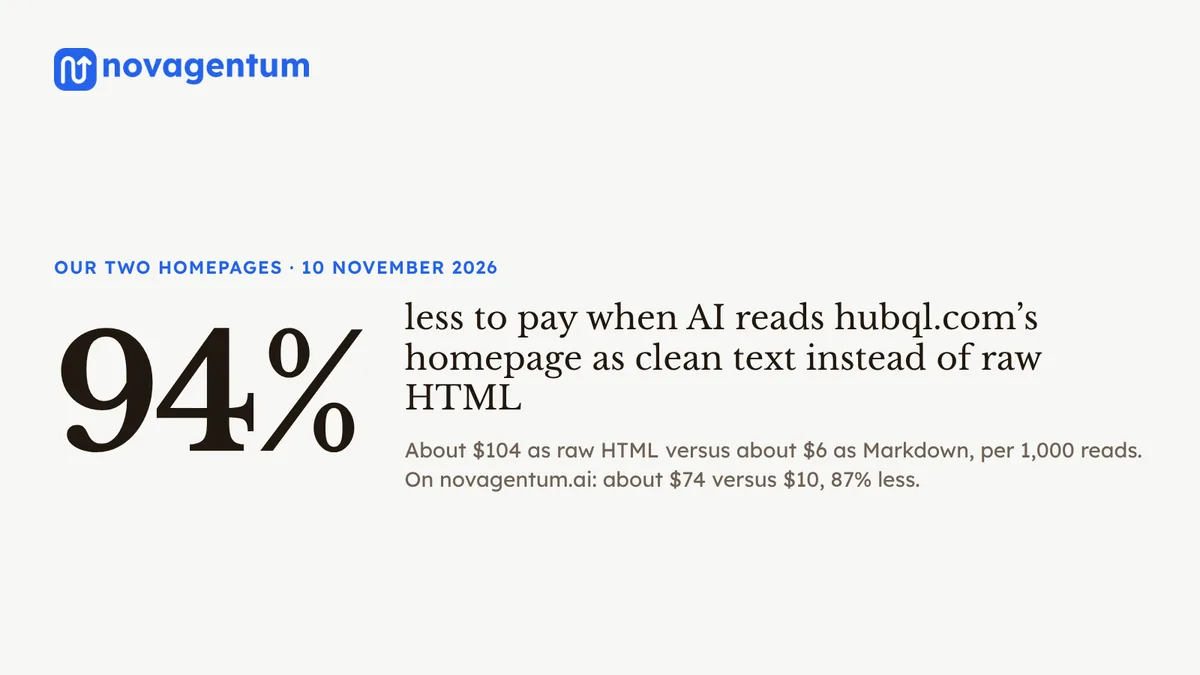
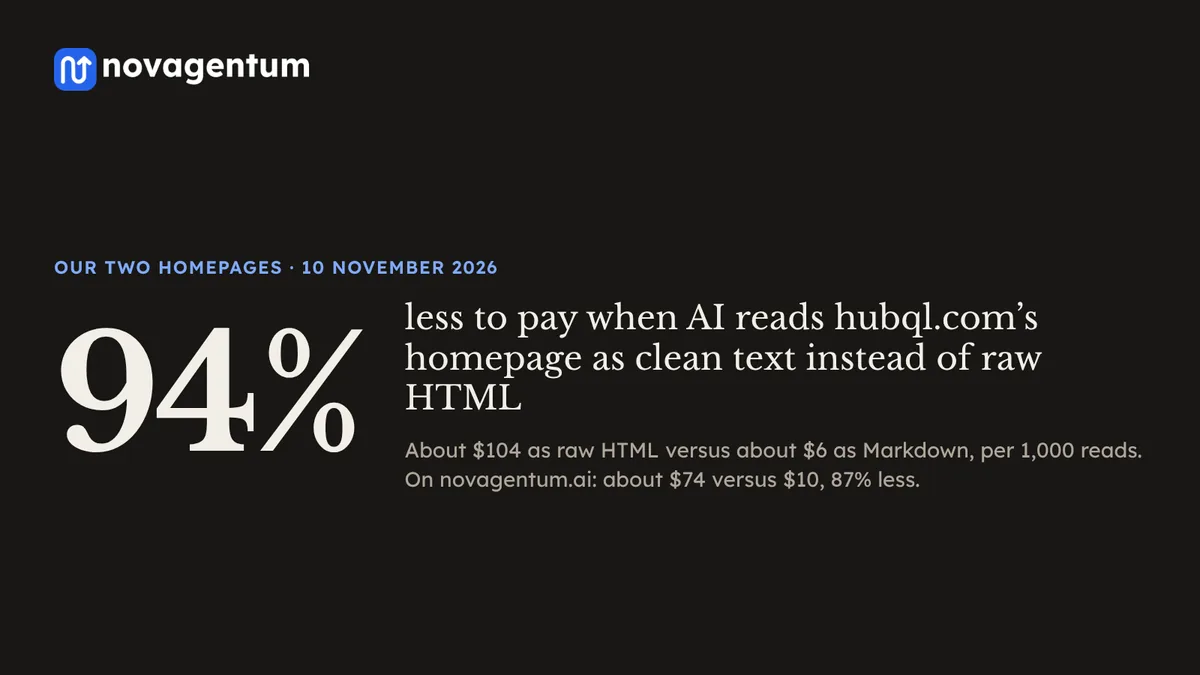
Imagine an AI reads each homepage 1,000 times. As raw HTML, the hubql.com homepage would cost about $104. As Markdown, it would cost about $6. That is about 18 times cheaper, or 94% less.
For novagentum.ai, the raw HTML would cost about $74 and the Markdown about $10. That is about 7.5 times cheaper, or 87% less.
Why the gap between the two sites? The hubql.com homepage has a short story wrapped in lots of code. So there is more to throw away. The novagentum.ai homepage has more words. So more of the file is already useful text.
Do other websites look the same?
Yes. Milldown tested five well-known public pages, counting tokens the same way we did.
How much smaller five public pages got as Markdown, in percent
Public data · Milldown token test · Accessed
Show the data
| Label | Percent smaller than raw HTML |
|---|---|
| GitHub project page | 95.4 |
| Wikipedia: Markdown | 81.7 |
| Wikipedia: Switzerland | 75.3 |
| MDN: HTTP guide | 72.4 |
| Python tutorial | 71.8 |
Markdown was between 72% and 95% smaller. Simple help pages, like the Python tutorial, saved the least. They don't have much extra code to start with. A GitHub page, which is mostly buttons and menus, saved the most.
Our two homepages, at 87% and 94%, fit right inside that range.
What if you cut out the menus too?
Turning a page into Markdown keeps all its text. That includes the menu, the footer and the cookie banner. Some tools go further. They keep only the main article and throw the rest away.
A bigger study, "Markdown saves more than they claim, and deletes more than they say", tested 193 article pages from 66 of the world's busiest websites.
Cost for an AI to read 1,000 typical article pages, in US dollars
Public data · Until Next Session study of 193 article pages · Accessed
Show the data
| Label | Typical page, US dollars per 1,000 pages |
|---|---|
| Raw HTML | 157.85 |
| Markdown of the whole page | 12.05 |
| Just the visible text | 4.32 |
| Main article only | 2.38 |
For a typical page, plain Markdown cut the cost by 91%. Keeping only the main article cut it by 98%. That sounds even better, but there is a catch.
The article-only tool almost always removed the menus, as planned. But it also cut real content. A typical page lost about 19% of the text found only on that page. Only 31% of pages kept at least 90% of it. Three pages lost all of their own text.
So there are two choices. Plain Markdown keeps the whole page. Article-only is cheaper, but it can quietly drop words you needed.
Does Markdown cost more than plain text?
Hardly. A test by KrabArena took 20 Wikipedia articles and wrote the exact same words in six formats. Then it counted the tokens with four different methods.
Same Wikipedia words in six formats: cost compared with plain text
Public data · KrabArena test on 20 Wikipedia pages · Accessed
Show the data
| Label | Times the cost of plain text |
|---|---|
| Plain text | 1 |
| Markdown | 1.012 |
| Simple HTML | 1.087 |
| Compact JSON | 1.129 |
| Spaced-out JSON | 1.313 |
| Article HTML | 2.345 |
Markdown cost only about 1% more than plain text. Other formats cost more. The HTML version cost more than twice as much as plain text, and it was the priciest format every single time.
And this HTML was already cleaned up. A normal web page, with all its menus and scripts, costs much more, as you saw above.
So Markdown is nearly as cheap as plain text. But it also keeps the headings, lists and tables. Those help the AI make sense of the page.
What this test can't tell us
- Two homepages are just examples. We measured two sites we run, on one day. They are not a sample of the whole web.
- Different tools give slightly different results. We used a tool called html2text to make the Markdown. Another tool might keep or drop a few different things.
- Token counts depend on the model. We counted with the method OpenAI's models use. Claude counts a bit differently, so the exact numbers would change. The savings in percent change much less.
- The public studies have limits too. Milldown tested only five pages. The 193-page study did not run the pages' code, so pages built in the browser looked almost empty. The Wikipedia test kept the words the same on purpose, so it does not show what you save on a normal live page.
What to do
- Send Markdown when you pay per token. It keeps the headings and cuts most of the cost.
- Use article-only tools with care. They save a little more, but check that they keep the words you need.
- Send raw HTML only when you need the code itself. For example, when you want the AI to check how a page is built.
That is what Novagentum is for. Scrape turns any page into clean Markdown. Crawl and Map handle whole websites. You can use it in the dashboard, through our API, or right inside Claude and ChatGPT over MCP. On pages like ours, you pay for the words, not for 7 to 18 times as much code.